Operationally demonstrated baseline
The application must evidence a solution already demonstrated in an operational environment and define a credible pathway from TRL 7 toward TRL 9.

EIT Culture & Creativity · Innovation Projects
01 · What the call wants
The application must evidence a solution already demonstrated in an operational environment and define a credible pathway from TRL 7 toward TRL 9.
Stage 1 develops the Business Development Plan around ownership and licensing, regulation, customer validation, production economics and commercialisation.
EURAN enters through Fashion. The pilot addresses digitalisation, competitiveness and responsible low-inventory production rather than presenting a cross-sector platform as the funded product.
02 · What EURAN proposes
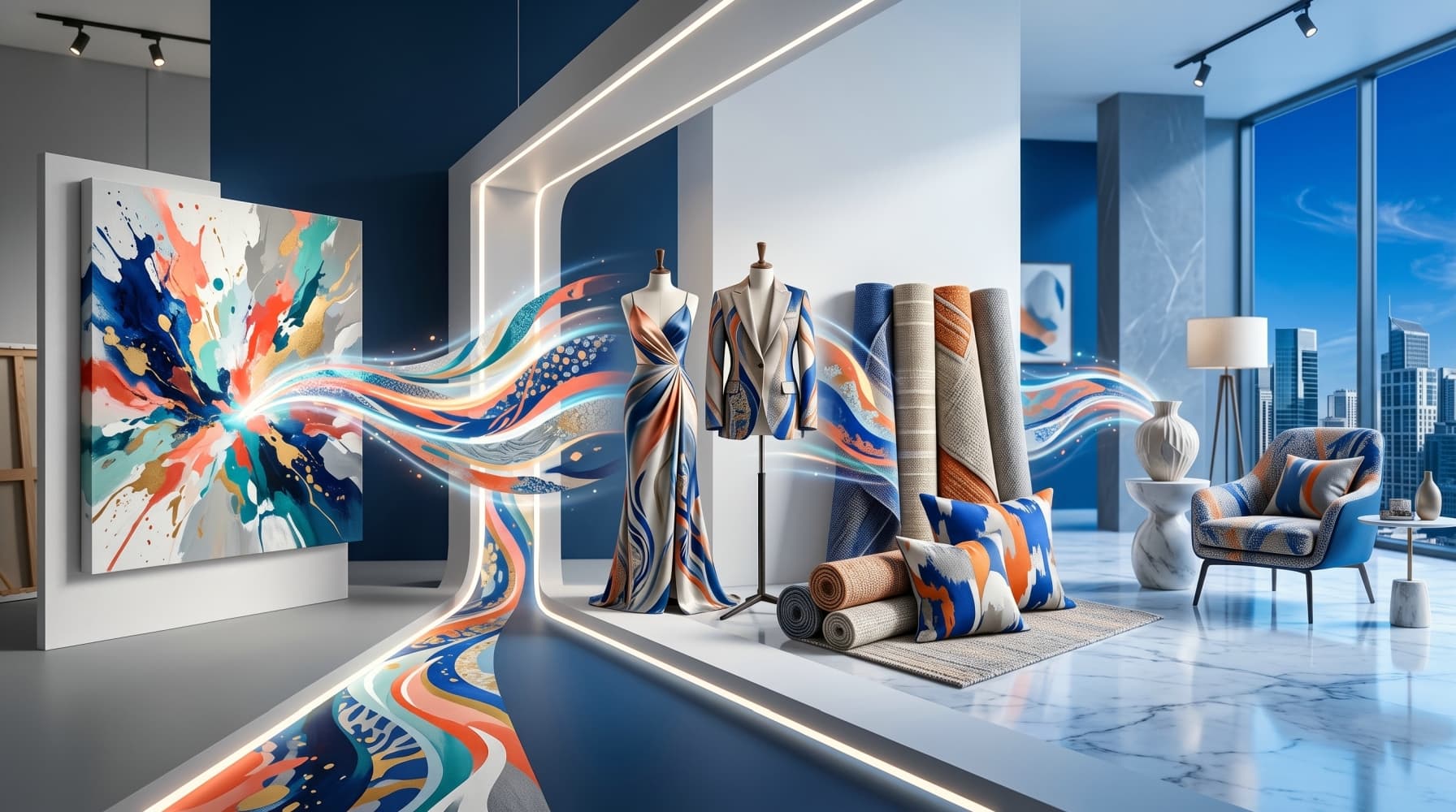
The ART-TO-DESIGN SYSTEM™ is the operating method; Fashion is the Stage 1 product focus. The pilot begins with authored works by Alexandre Mimoglou and Maria Papafili and connects them to a controlled fashion/textile workflow: rights and provenance records, digital configuration, responsible production choices and market deployment.
The existing EURAN configuration-to-production chain provides the operational baseline. Stage 1 does not pretend that every proposed system layer is already complete; it defines, tests and structures the business-development path needed to turn that baseline into a repeatable, rights-aware fashion innovation.
03 · Why EURAN
Alexandre Mimoglou's contemporary authored work provides one directly controlled corpus for the Fashion pilot and its provenance records.
Maria Papafili's original collections provide a second living-artist corpus for licensing, attribution and product development under a defined rights structure.
The method has a historic industrial precedent in Alexandre Mimoglou's textile work commercialised through Knoll International Europe. This establishes lineage and delivery credibility; the current TRL claim must still rest on present operational evidence.
EURAN already operates a digital configuration and print-on-demand workflow capable of moving selected designs into physical products and fulfilment.
The wider catalogue demonstrates product-configuration capacity at scale, but it is not the funded innovation. Stage 1 concentrates on a focused authored Fashion pilot.
EURAN's wider production history demonstrates long experience converting artistic direction into specifications, production, quality control and delivered physical outcomes.
04 · What Stage 1 develops
The pilot is designed so that each selected work carries authorship, source, rights status, reproduction permissions and product-use conditions. Stage 1 structures and tests the first working register for the focused pilot corpus.
A focused set of fashion and textile applications will be selected from the two living-artist corpora and used to test attribution, configuration, pricing and market response.
Stage 1 will define substrate criteria, an appropriate European print/conversion route, inventory-minimisation rules and a practical approach to leftovers, returns or take-back where feasible.
The Business Development Plan will define target customers, pricing, licensing, sales channels and the profile of the mandatory Stage 2 commercialisation partner.
The pilot will define transparent authorship, attribution and licensing practices and integrate Gender, Equality, Diversity and Inclusion considerations into creator participation and market deployment.
The Stage 1 plan will map the required co-financing and Revenue Sharing Agreement implications before any Stage 2 commitment is made.
05 · From Stage 1 to market deployment
The funded Stage 1 proposition remains within Fashion. Interiors, hospitality, architectural surfaces, the wider artist network, the Stockholm archive, public-domain masterworks and EURAN XPO™ remain outside the core pilot. They may become later replication or commercialisation routes only after the Fashion system is evidenced and market-ready.
The Stage 2 direction is a compact consortium led by the Stage 1 applicant with a commercialisation partner such as a responsible textile manufacturer, converter, distributor or licensing/market-access operator, plus an optional third participant where justified.
06 · Participation
The concept is being prepared for the 30 October 2026 submission. The final applicant vehicle and legal-form eligibility are being verified before submission. Stage 1 concerns the innovation system and Business Development Plan; it is financially and operationally separated from the 12 October Shape proposal, which concerns venture execution and commercial acceleration. No activity or cost is intended to be funded twice.